Main-track train collision and derailment
BNSF Railway Company
Freight trains R-NWE8041-18I and M-VBCEVE1-18T
Mile 133.54, New Westminster Subdivision
Delta, British Columbia
The occurrence
On 19 November 2023, at approximately 0222 Pacific Standard Time, BNSF Railway Company freight train R-NWE8041-18I, proceeding northbound on the New Westminster Subdivision, passed a Stop signal indication and collided with southbound BNSF Railway Company freight train M-VBCEVE1-18T as it was entering Oliver siding at the north siding switch (Mile 133.54) in Delta, British Columbia. On the southbound train, 2 multi-platform intermodal cars derailed. On the northbound train, 2 locomotives and 5 cars derailed upright, including 2 tank cars loaded with liquefied petroleum gas (UN1075) and 1 residue tank car last containing liquefied petroleum gas. In addition, the fuel tank on the east side of the lead locomotive sustained extensive damage, releasing approximately 8000 litres of diesel fuel. No injuries were reported.
Investigation information
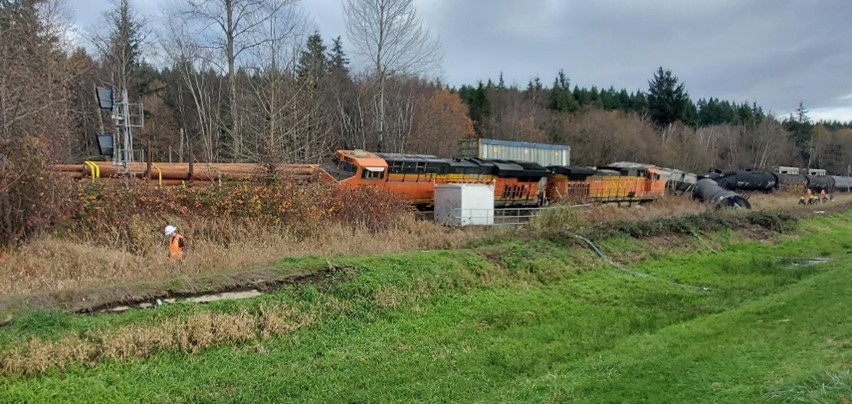
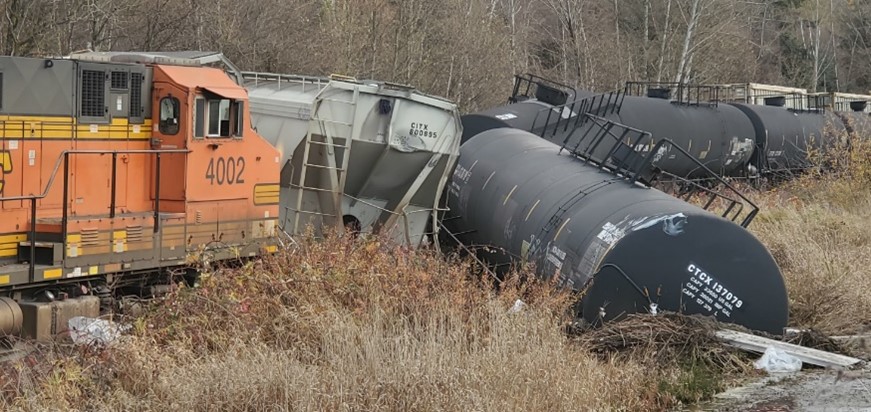
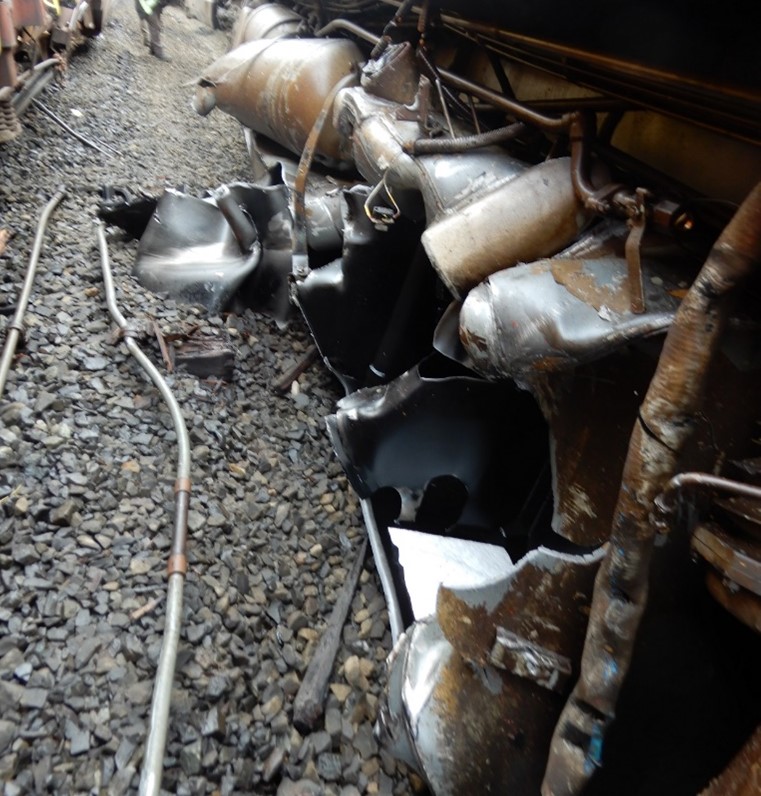
Download high-resolution photos from the TSB Flickr page.
Class of investigation
This is a class 3 investigation. These investigations analyze a small number of safety issues, and may result in recommendations. Class 3 investigations are generally completed within 450 days. For more information, see the Policy on Occurrence Classification.
TSB investigation process
There are 3 phases to a TSB investigation
- Field phase: a team of investigators examines the occurrence site and wreckage, interviews witnesses and collects pertinent information.
- Examination and analysis phase: the TSB reviews pertinent records, tests components of the wreckage in the lab, determines the sequence of events and identifies safety deficiencies. When safety deficiencies are suspected or confirmed, the TSB advises the appropriate authority without waiting until publication of the final report.
- Report phase: a confidential draft report is approved by the Board and sent to persons and corporations who are directly concerned by the report. They then have the opportunity to dispute or correct information they believe to be incorrect. The Board considers all representations before approving the final report, which is subsequently released to the public.
For more information, see our Investigation process page.
The TSB is an independent agency that investigates air, marine, pipeline, and rail transportation occurrences. Its sole aim is the advancement of transportation safety. It is not the function of the Board to assign fault or determine civil or criminal liability.