
Introduction
This Strategic Plan positions the TSB as a trusted, modern, and impactful safety investigation organization. By focusing on Timeliness, Impact, and Excellence, the TSB will deliver safety information that is credible, timely, and capable of contributing to meaningful and lasting safety improvements in the public interest. In this Strategic Plan, “safety information” refers collectively to the TSB’s investigation reports, findings, recommendations, safety communications, and related outputs intended to advance transportation safety.
Over the next two years, the TSB will operate in an environment characterized by increasing transportation system complexity, growing public and stakeholder expectations for timely and transparent safety information, heightened scrutiny of evidence and credibility, and continued pressure to modernize tools, data, and ways of working within finite resources. This plan responds to that context by strengthening how the organization works, how it engages, and how it delivers its mandate—reflected in the three strategic objectives of Timeliness, Impact and Excellence.
Across all objectives, in carrying out its mandate, the TSB exercises its investigative authority and related analytical work independently and without direction or influence from regulators, industry, or other stakeholders. The TSB will maintain the integrity and rigour of its investigations and demonstrate respect for people in how it engages with employees, stakeholders, and those affected by transportation occurrences. The organization will also sustain a strong focus on organizational health, inclusion, and continuous improvement—recognizing that a healthy, supported workforce and a culture of learning are essential to delivering trusted safety information and maintaining public confidence.
The priorities outlined in this plan are grounded in the TSB’s statutory mandate to advance transportation safety. This plan therefore focuses on strengthening how the organization fulfills its mandate in a changing operational environment. Where operational trade-offs arise, decisions will be guided by the TSB’s statutory mandate, investigative independence and integrity, the objective of advancing transportation safety in the public interest, and the organization’s core values.
Vision
A world‑leading, trusted safety investigation organization that influences lasting changes to advance transportation safety.
Our mandate
The Transportation Safety Board of Canada advances transportation safety by independently investigating occurrences, identifying safety deficiencies, and communicating findings and recommendations to influence change.
The TSB is not a regulator and does not attribute blame or liability. Our work is grounded in evidence, professionalism, and objective, impartial analysis.
The three strategic objectives are mutually reinforcing and will be pursued in parallel; their presentation does not reflect a hierarchy of importance.
Strategic objectives
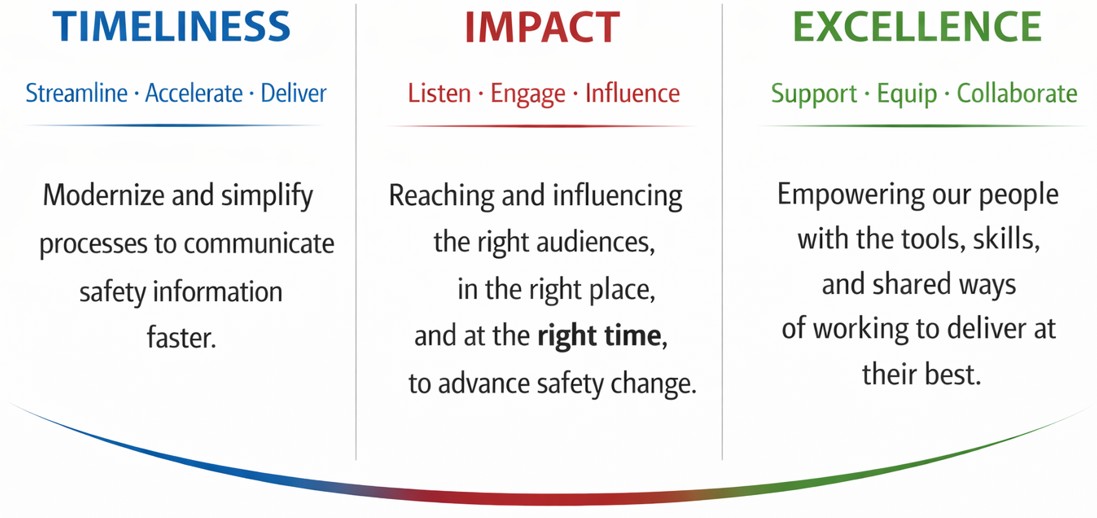
Timeliness
Modernize and simplify processes to communicate safety information faster.
The TSB will strengthen its ability to communicate safety information faster by modernizing and streamlining how work is planned, sequenced, and delivered across the organization. Achieving this will require coordinated contributions from both operational and enabling functions, ensuring that staffing, procurement, governance, and digital tools are aligned to support investigative capacity and predictable delivery. By streamlining workflows, accelerating decision making, and equipping employees with the right tools to support speed, consistency, and responsiveness, the TSB will shorten the time between deployment to an occurrence and the publication of the final investigation report. The organization will also examine how and when safety information is shared to enable earlier communication, where appropriate, supporting timely awareness and maximum safety payoff—without compromising rigour or credibility.
To advance this objective, the TSB will
- modernize workflows using lean end-to-end processes that reduce sequencing delays and support faster completion of investigations;
- manage timeliness as a defined performance outcome through clear expectations, active timeline oversight, and continuous improvement across investigations;
- establish early investigative planning and risk-informed scoping to set appropriate investigation depth and timelines, while allowing scope to evolve as evidence and safety issues emerge; and
- enable earlier, fit-for-purpose sharing of safety information alongside investigations to support timely awareness and safety action.
Impact
Reaching and influencing the right audiences, in the right place and at the right time, to advance safety change.
The TSB will increase the impact of its safety communications by strengthening engagement with stakeholders and deepening its understanding of what drives action on safety information. While decisions ultimately rest with stakeholders, the TSB’s role is to ensure its work reaches the right audiences and effectively informs their awareness, decisions, and management of safety risks. Accordingly, impact will be assessed through observable signals of awareness, engagement, and safety-relevant response, rather than through control over stakeholder decisions. This includes learning how different audiences access, interpret, and respond to investigation findings and recommendations, and what conditions, formats, and timing best support the adoption of safety-reinforcing measures. Using these insights, the TSB will evolve its communications, and engagement approaches to increase the likelihood that stakeholders act on safety issues identified by the TSB, advancing meaningful and lasting safety change—while preserving the independence, rigor, and credibility of its investigative work.
To advance this objective, the TSB will
- deepen its understanding of industry challenges, stakeholder priorities and initiatives, decision-making contexts, and barriers to action through ongoing dialogue with stakeholders;
- strengthen connections with audiences by understanding how, where, and when they access TSB safety information and what enables them to act on it; and
- shape understanding and prompt action by evolving how safety information and recommendations are presented to better align with audience behaviors, incentives, and decision-making needs.
The TSB will remain attentive to the limits of its influence and will assess impact in a manner consistent with its independent mandate.
Excellence
Strengthening organizational capability by equipping our people with the tools, skills, support, and shared ways of working needed to deliver high-quality, consistent results.
The TSB will continue to strengthen organizational excellence by investing in the tools, skills, and training that employees need to succeed, and by strengthening how work is carried out across the organization. Excellence is reflected not only in what the TSB delivers, but in how employees work together—through clear roles, constructive challenge, shared accountability, and collaboration across functions. By supporting a culture of continuous learning and effective collaboration, the organization will be better positioned to adapt, innovate, and continue to deliver high-quality, trusted safety communications and products.
To advance this objective, the TSB will
- strengthen professional mastery and workforce sustainability by investing in skills development, lean processes and knowledge sharing that reinforces the quality, rigor, and integrity of evidence-based work;
- equip employees with modern digital tools and data-driven methods to improve workflow efficiency, support high-quality analysis, and enable consistent, coordinated, and high-quality investigative work across functions
- foster an inclusive and healthy workplace that supports collaboration and employee well-being, particularly in the context of complex and trauma-informed work; and
- strengthen collaboration across functions by clarifying roles, decision-making authorities, and expectations for constructive challenge, enabling teams to work together more effectively and consistently.
Monitoring progress
Progress under this Strategic Plan will be monitored using a focused set of outcome-oriented indicators that measure how effectively the TSB delivers safety information, how that information influences action, and how well the organization enables its people to do their work. Measures will be monitored regularly and used to inform management decisions, continuous improvement, and accountability.
The indicators below are intended to support transparency, learning, and course correction. They are directional measures of progress rather than fixed performance commitments, and results will be interpreted in the context of operational realities and the broader fiscal and policy environment.
Timeliness will be measured by the TSB’s ability to deliver safety information faster and more predictably across the investigation lifecycle. Indicators will include the following:
- Trends in the average end-to-end investigation cycle time, by investigation type
- Adherence to key investigation milestones and decision points
- Frequency and timeliness of early safety communications, where appropriate
- Reduction in late-stage delays attributable to rework, sequencing, governance, or enabling service processes
- Timely delivery of enabling services and modernization initiatives that directly support investigative capacity and workflow efficiency
Impact will be measured by the extent to which the TSB’s work influences stakeholder behavior and contributes to safety-reinforcing action. Indicators will include the following:
- Trends in stakeholder action and risk-reduction measures related to issues identified on the Board’s Watchlist
- Stakeholder engagement and responsiveness, particularly among targeted audiences
- Trends in stakeholder acceptance and implementation of TSB safety recommendations
- Evidence that TSB safety information informs decisions, policies, and operational changes across targeted audiences
Excellence will be measured by the quality of investigative outputs, the effectiveness of how work is carried out, and the health and sustainability of the workforce. Indicators will include the following:
- Quality and credibility of investigative outputs
- Workforce capacity and resilience, including workload sustainability and retention in key roles
- Employee experience and collaboration, monitored through the Public Service Employee Survey and other internal workforce indicators:
- Engagement and trust
- Psychological health and safety
- Inclusion and respect
- Confidence in tools, training, and shared ways of working
Together, these measures will enable the TSB to track progress, identify areas for improvement, and ensure the organization remains focused on delivering timely, impactful, and high-quality safety information. Progress will be reviewed periodically and adjustments made as required to respond to evolving risks and resource realities.
Conclusion
This Strategic Plan sets a clear direction for how the TSB will deliver credible, timely safety information that contributes to meaningful and lasting safety improvements in the public interest—by communicating safety information more quickly, strengthening its influence on safety action, and strengthening how work is carried out across the organization.
This plan provides a shared framework to guide decisions, align efforts, and support continuous improvement, reinforcing the TSB’s role in advancing transportation safety and contributing to lasting safety improvements.
Through this approach, the TSB will continue to investigate transportation occurrences, identify safety deficiencies, and communicate findings and recommendations that support the ongoing advancement of transportation safety in the public interest.