
November 3, 2025
Director General, Rail Safety and Security
Transport Canada
Enterprise Building, 14th floor
427 Laurier Avenue West
Ottawa ON K1A 0N5
On 24 September 2025, VIA Rail Canada Inc. (VIA) passenger train 033/24, transporting 161 passengers between Québec, Quebec, and Ottawa, Ontario, was proceeding westward at 70 mph on the south main track of Canadian National Railway Company’s (CN) St-Hyacinthe Subdivision near Mont-Saint-Hilaire, Quebec. At about 0822,All times are Eastern Daylight Time. upon travelling over the Benoît Road public grade crossing, located at Mile 50.84, the train experienced a rough track condition and simultaneously the train crew received alerts indicating mechanical issues. The train was immediately brought to a controlled stop. A subsequent inspection revealed that the train had passed over a section of damaged rail at the crossing location, which resulted in small pieces of rail to become dislodged, causing mechanical damage to the locomotives and passenger cars. The train was later cleared to continue to travel to Montréal Central Station at reduced speed, where passengers were transferred to another train to continue their journey toward Ottawa. There were no injuries.
The St-Hyacinthe Subdivision is part of CN’s main rail corridor linking Canada from east to west. In the area of the occurrence, the subdivision comprises Class 5 double tracks, which handle approximately 12 passenger trains and 12 freight trains per day. The authorized speed is 95 mph for passenger trains and 65 mph for freight trains.
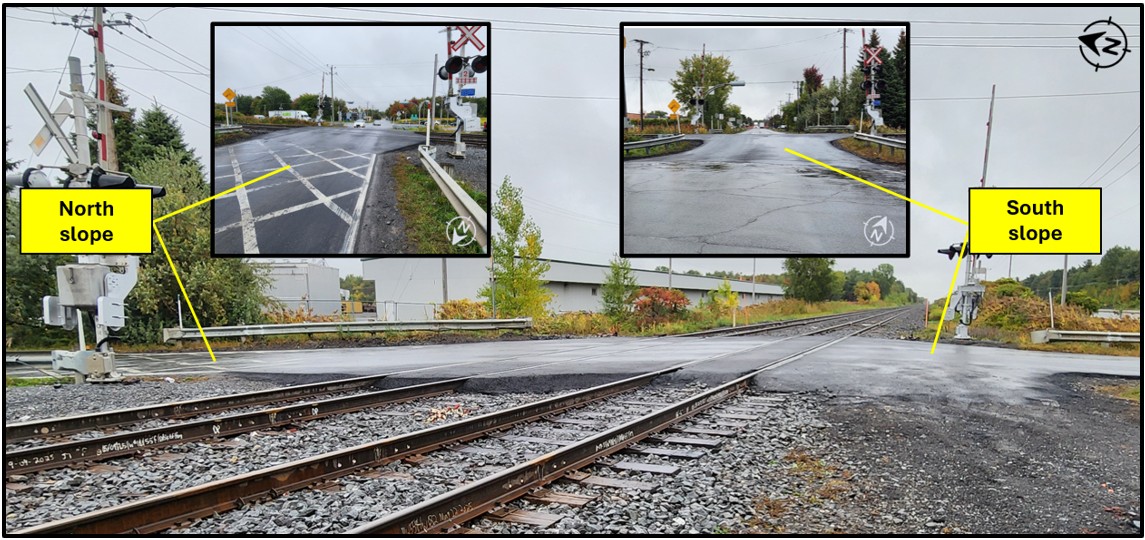
The Benoît Road crossing connects 2 major roadways in the area: Highway 20 to the north and Sir Wilfrid Laurier Boulevard (Road 116) to the south. The tracks are located higher than the surrounding terrain; as a result, the road approaches on both sides of the crossing are on a grade. The rails are fitted with rubber flangeways which provide a smooth transition with the asphalt pavement and the rail heads sit flush with the pavement at the crest of the crossing (Figure 1).
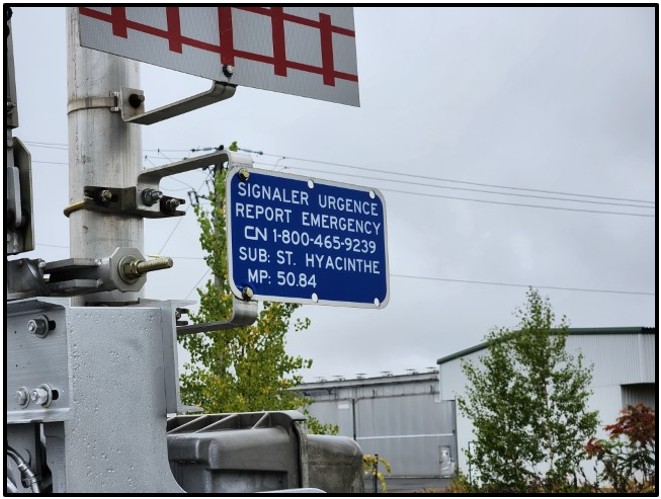
The crossing is equipped with standard automatic warning devices (flashing lights, bells and gates). There are reflectorized crossbucks, 2-track signs, as well as emergency notification signsAn emergency notification sign provides grade crossing location information and the railway company’s telephone number needed to report or notify about emergencies at the crossing. (Figure 2) posted on each side of the grade crossing facing traffic, in compliance with Transport Canada–approved Grade Crossings Regulations. No Low Ground Clearance at Railway CrossingThis sign indicates a vertical roadway alignment that may result in the underside of long wheelbase, low ground clearance vehicles striking the road surface and/or rails while crossing the tracks. signs were observed.
Approximately 2 weeks prior to the occurrence, the crossing infrastructure had undergone complete rehabilitation workThe work at this location had been scheduled for 2025 as part of CN’s regular crossing maintenance program. where the rails, asphalt pavement and other major components were replaced.
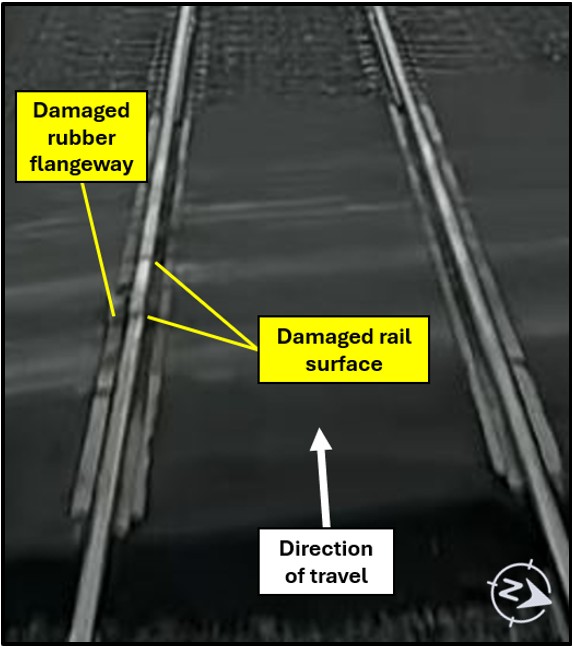
The video from the forward-facing camera of train VIA 033/24 was obtained and reviewed by TSB investigators. The rubber flangeway on the south side of the rail was observed to be torn and the rail surface appeared uneven and damaged (Figure 3).
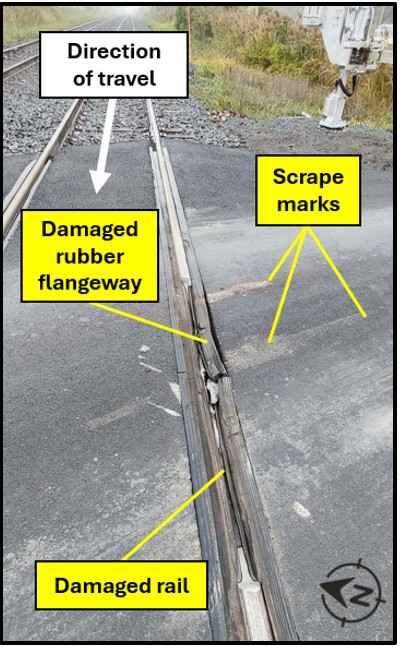
The TSB also reviewed pictures of the crossing following the occurrence. Large scrape marks could be observed on the road surface leading to the south rail, the south-side rubber flangeway was torn and an 8-foot section of rail head was missing (Figure 4). The presence of the scrape marks and the nature of the observed damage are consistent with the south rail being struck by the underside of a long wheelbase, low ground clearance vehicle travelling northbound.
Following the occurrence, the damaged track components were replaced and the crossing surface was remediated.
Prior to the occurrence, no notice of damage or possible damage to the rail infrastructure at the Benoît Road crossing had been received by CN.
Certain crossing configurations may cause the underside of long wheelbase, low ground clearance vehicles to contact and damage railway tracks. In some cases, such contact may also result in a vehicle to become immobilized on the crossing, obstructing the path of oncoming trains. These situations can lead to collisions or derailments, potentially resulting in serious injuries or fatalities.
Consequently, Transport Canada may wish to consider reviewing provisions for the posting of Low Ground Clearance at Railway Crossing signs for crossings with approaches on a grade or where there are risks of contact by the underside of long wheelbase, low ground clearance vehicles.
Transport Canada may also wish to consider working with provincial authorities and Operation Lifesaver to enhance commercial vehicle driver awareness of the risks their vehicles could pose to rail infrastructure at crossings, and to encourage them to report all incidents involving the underside of their vehicle contacting the rail, including any infrastructure damage, using the posted railway company contact information.
The TSB would appreciate being informed of what action, if any, will be taken in this regard.
Yours sincerely,
Original signed by
Vincenzo De Angelis
Director, Investigations - Rail/Pipeline
cc.
Senior Director, Operations Management, Rail Safety and Security
Transport Canada
Director, Policy, Legislative and Regulatory Affairs, Rail Safety and Security
Transport Canada
Vice President, Safety-Regulatory
Canadian National Railway Company
Senior Manager, Regulatory Affairs, Safety
Canadian National Railway Company
Director, Rail Safety Governance
VIA Rail Canada Inc.
Senior Director, Operations & Regulatory Affairs
Railway Association of Canada
National Director
Operation Lifesaver
Ministerial Coordinator for Rail Safety, Air and Rail Transport Directorate
Quebec Ministry of Transportation and Sustainable Mobility